2026-09-19 · Getting started↓§
I recently started learning the violin. I'm keeping my practice notes and music theory notes here.
I'll update this page as I learn and link to any related blog posts.
What I'm learning↑↓§
I'm working on Pachelbel's Canon in D and A Thousand Years. Still very much a beginner.
From my notebook to the circle of fifths↑↓§
Here's the note map from my notebook, followed by an interactive circle of fifths.
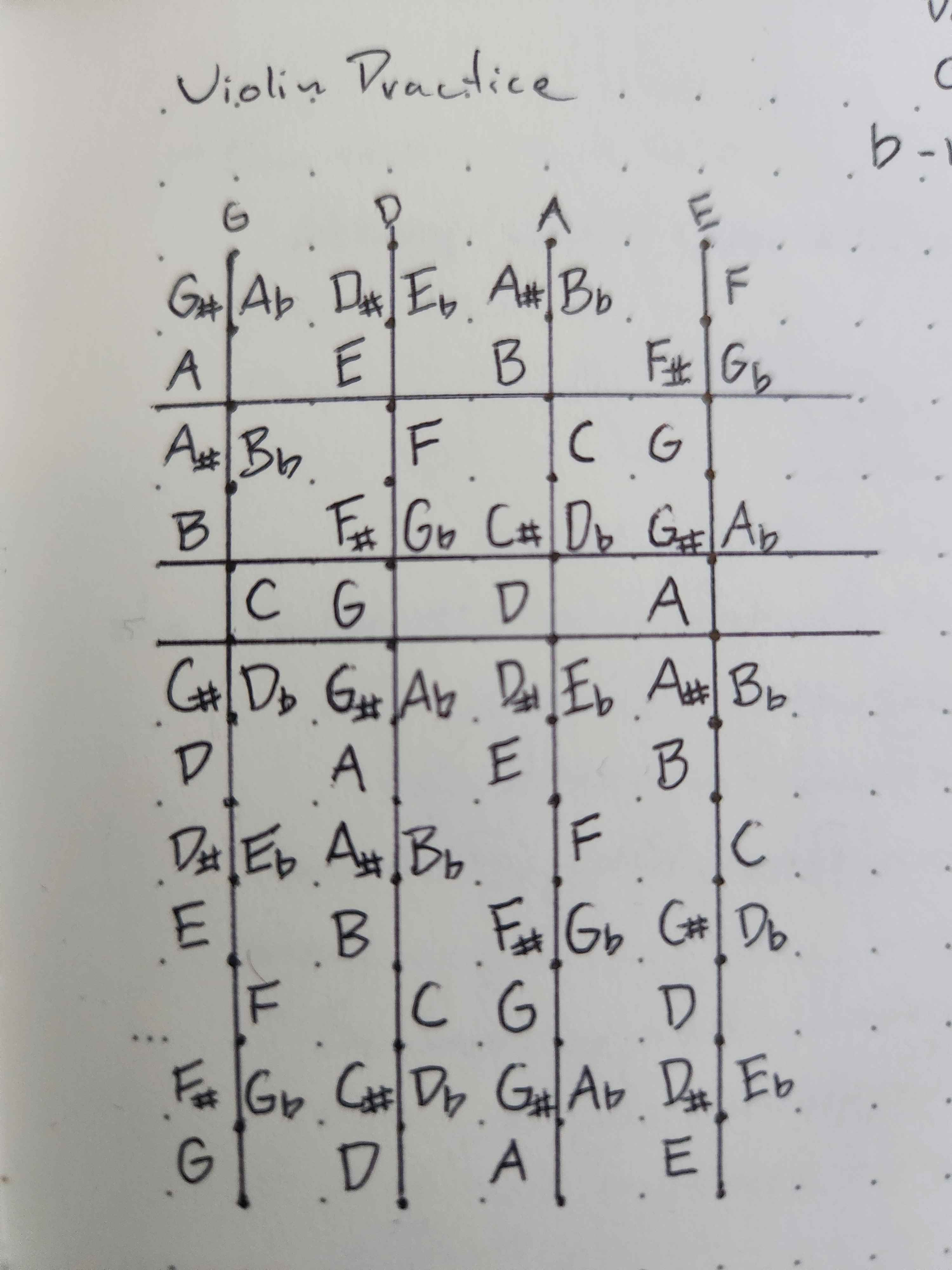
Down a column: each step raises the pitch by one semitone (also called a half step). On the G string, that starts G, G♯/A♭, A, A♯/B♭, B, C. B–C and E–F are already a semitone apart; there's no extra note between them. After twelve steps, the letter name repeats an octave higher. Moving down the drawing means moving up in pitch.
Across a row: the strings start G–D–A–E, each a perfect fifth above the previous string. A perfect fifth spans seven semitones; the name “fifth” comes from counting five letter names, including both ends: G, A, B, C, D. Raising every string's note by the same number of semitones preserves that relationship.
The photo is a note-name map, not a scale drawing of finger positions. The violin has no frets, and equal pitch steps don't occupy equal physical distances along a string.
What the circle means↑↓§
The circle of fifths arranges the twelve pitch classes by fifths instead of by semitones. A pitch class groups together notes with the same name in different octaves. Starting at C and moving clockwise gives C–G–D–A–E–B, then the sharp/flat side of the circle, eventually returning to C. Wrapping octaves together is what lets us draw the sequence as a circle.
That puts the open strings G → D → A → E next to each other. Every other row of my drawing makes another four-note stretch around the same circle. Try the slider at 0, then 1, then 12: the highlight moves, but those four notes stay neighbors. At 12, the names return to the start, an octave higher on the instrument.
Follow a row from the notebook
Read left to right, then follow 1 → 2 → 3 → 4 around the circle. Each step is a fifth clockwise.
Clockwise: +7 semitones
Octaves wrap around
The connected notes trace your row. Select any circle button to explore its major key below.
2 sharps: F♯, C♯
Scale: D E F♯ G A B C♯ D
This is the key of Canon in D. Its F and C are sharp.
Why some notes have two names↑↓§
The paired names in my drawing, such as G♯ and A♭, are called enharmonic spellings. In twelve-tone equal temperament, they name the same sounding pitch. The spelling still matters: it tells us how a note functions in a scale or chord. Violinists can also adjust intonation to the musical context, so this diagram is a map of note names rather than a complete tuning system.
Across the row one semitone above the open strings, my drawing gives G♯/A♭, D♯/E♭, A♯/B♭, F. Reading those as A♭–E♭–B♭–F makes the sequence of written fifths clear. The circle chooses convenient spellings; it doesn't change the notes in the notebook.
From notes to keys: why Canon has two sharps↑↓§
The same circle also organizes major keys, which are sets of notes centered on a tonic. Starting with C major, which has no sharps or flats, move one step clockwise to G major: it has F♯. Move another step to D major: it has F♯ and C♯. Those are the two sharps in Canon in D. Going the other way from C, F major has one flat (B♭), and B♭ major has two (B♭ and E♭).
This doesn't mean playing the open D string puts you in D major. One is a note; the other is a musical key. D major uses D–E–F♯–G–A–B–C♯–D. Its scale steps follow whole–whole–half–whole–whole–whole–half, where a whole step is two semitones.
Loading sheet music…
View ABC notation
X:1
T:D major - one octave
M:4/4
L:1/4
K:D clef=treble
D E F G | A B c d |]
Try it: find D on the circle and read its key signature. Then find F♯ and C♯ in the notebook. Finally, compare the scale above with the Canon phrase below: the key signature applies to both.
Further reading: Open Music Theory: major scales and key signatures and Yamaha: the violin's strings.
Canon in D↑↓§
Here's the opening phrase of the first violin part. In D major, the key signature makes F and C sharp, even though the individual notes don't have sharp signs beside them. The key signature applies to the whole phrase.
Loading sheet music…
View ABC notation
X:1
T:Canon in D - opening violin phrase
C:Johann Pachelbel
M:4/4
L:1/4
K:D clef=treble
f2 e2 | d2 c2 | B2 A2 | B2 c2 |]
This excerpt comes from Pachelbel's public-domain composition. The full score is available on IMSLP.
A look at the manuscript↑↓§
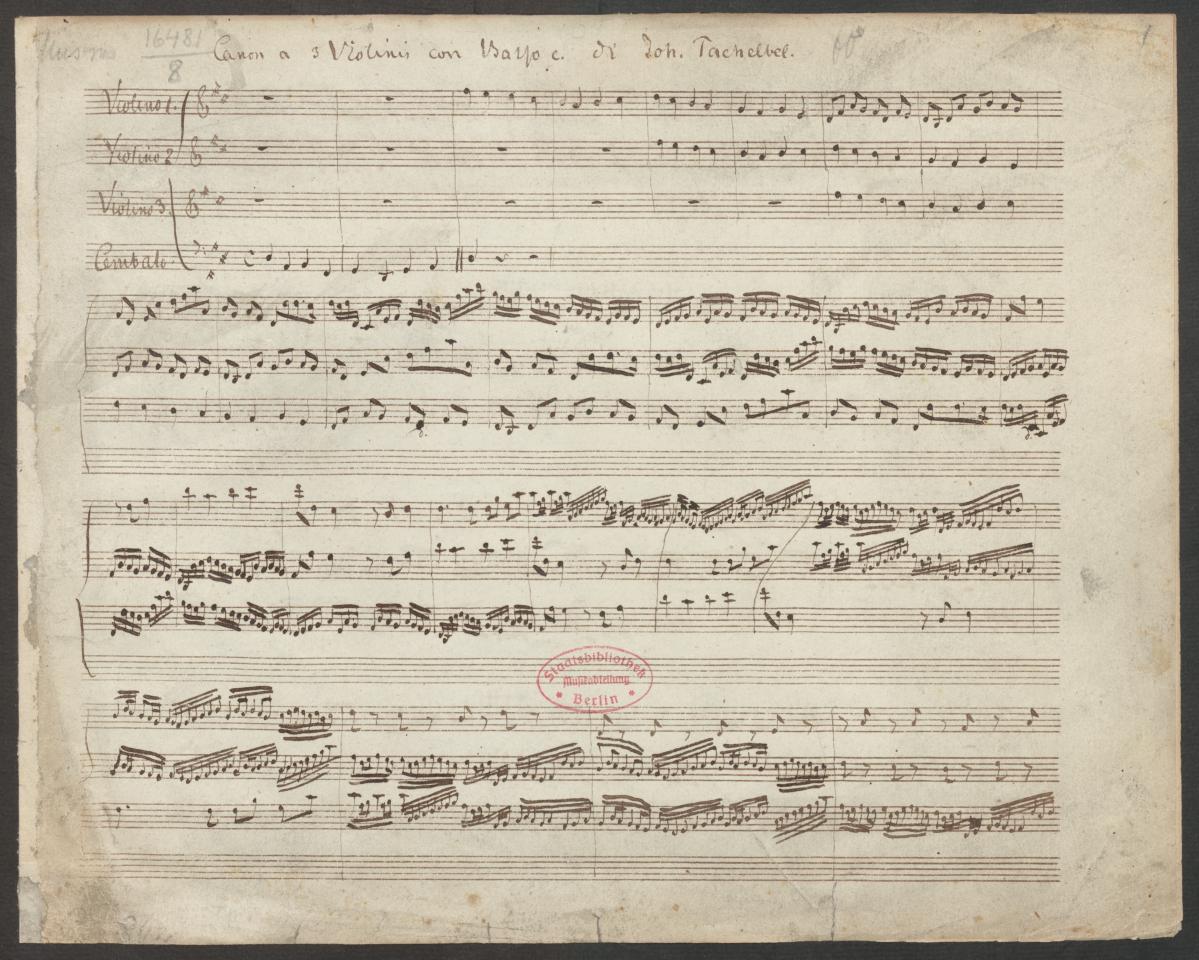
This manuscript page shows all three violin parts above the repeating bass line.
Open the image at full size · Image source · Public-domain documentation for this manuscript page
Open strings↑§
Here are the violin's four open strings, from lowest to highest: G, D, A, and E.
Loading sheet music…
View ABC notation
X:1
T:The violin's open strings
M:4/4
L:1/4
K:C clef=treble
"G"G,4 | "D"D4 | "A"A4 | "E"e4 |]