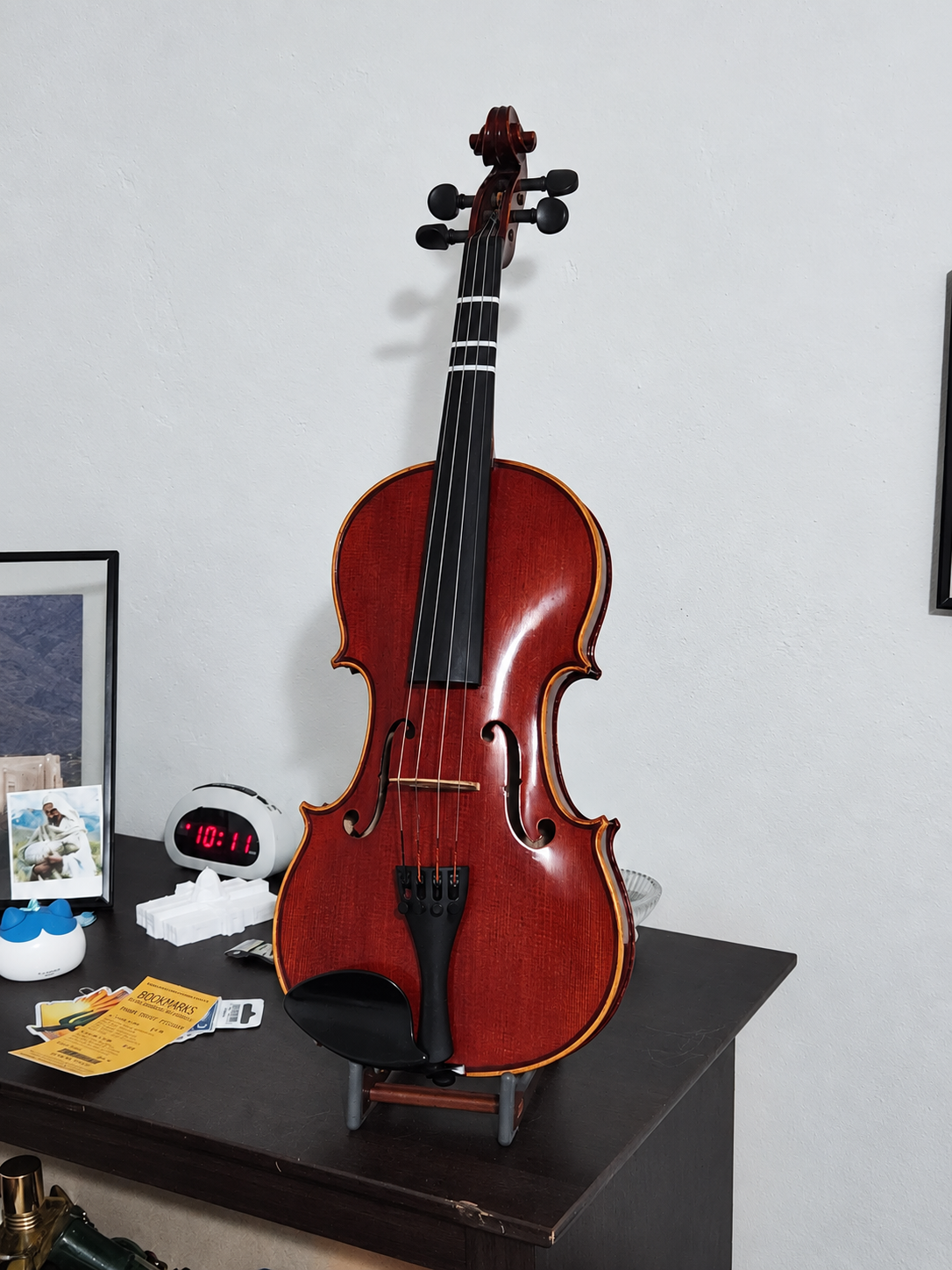
When I walked into the local Bookmans on the 17th of October, I wasn't expecting to walk out with a beautiful new violin.
The longer story of why I started playing now lives in my Learning the Violin project. This is the part where I unexpectedly came home with another instrument.
I paid $250 for the red violin, its case, and its bow. My other violin—a Sophia Marie 305-E that I think of as my trainer—cost $450. Used instruments do not line up neatly by price, but I still wanted to know whether the cheaper violin was actually the better one.
The label inside§
The label reads:
Synergy Hand Made Violins
Angel model 400, 2011
Sold through the workshop of Jeffrey Robinson, Violin Maker
The wording matters. It says sold through, not made by. Jeffrey Robinson is a Flagstaff luthier; this was most likely a commercial instrument selected and sold through his workshop.
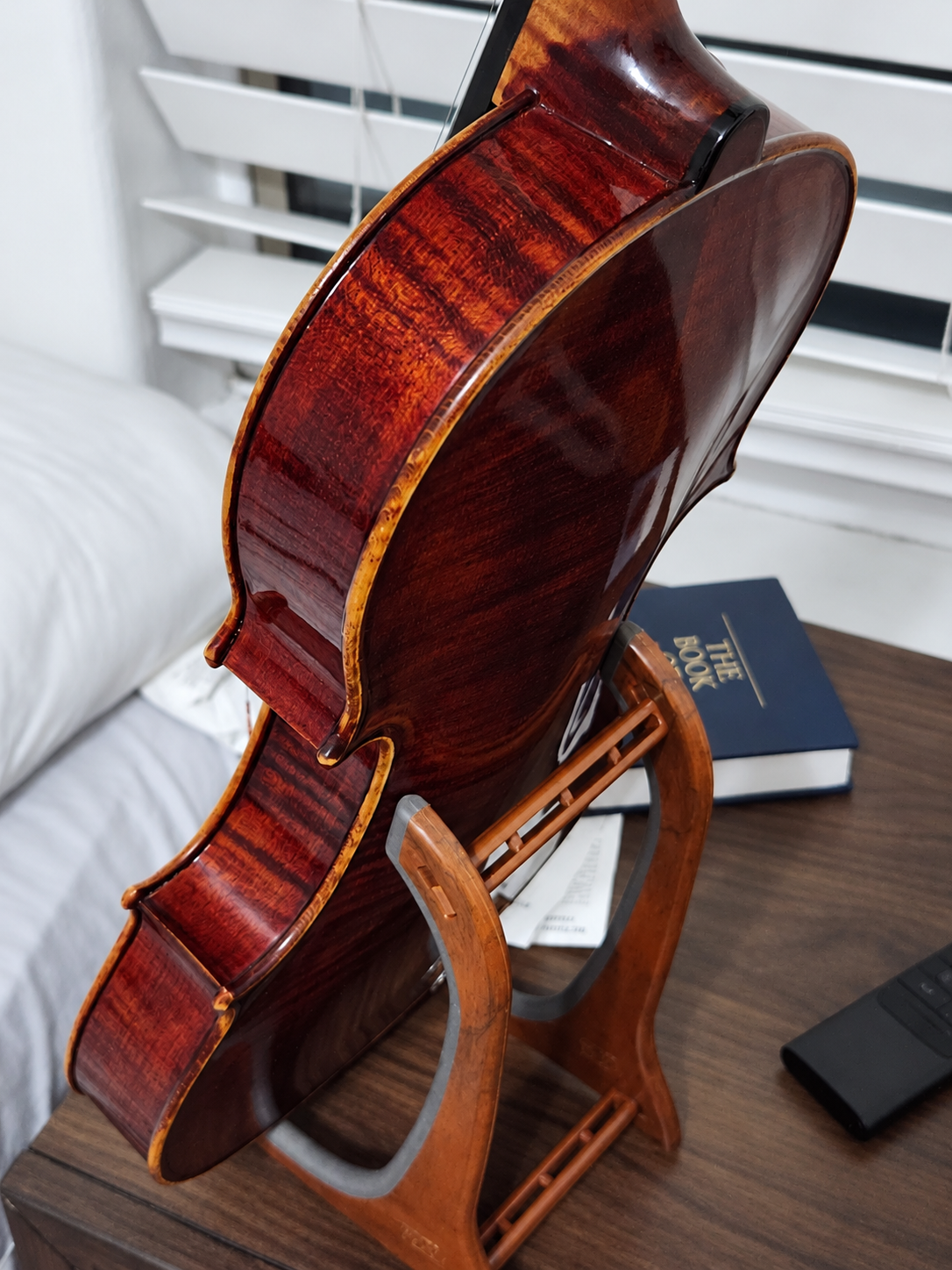
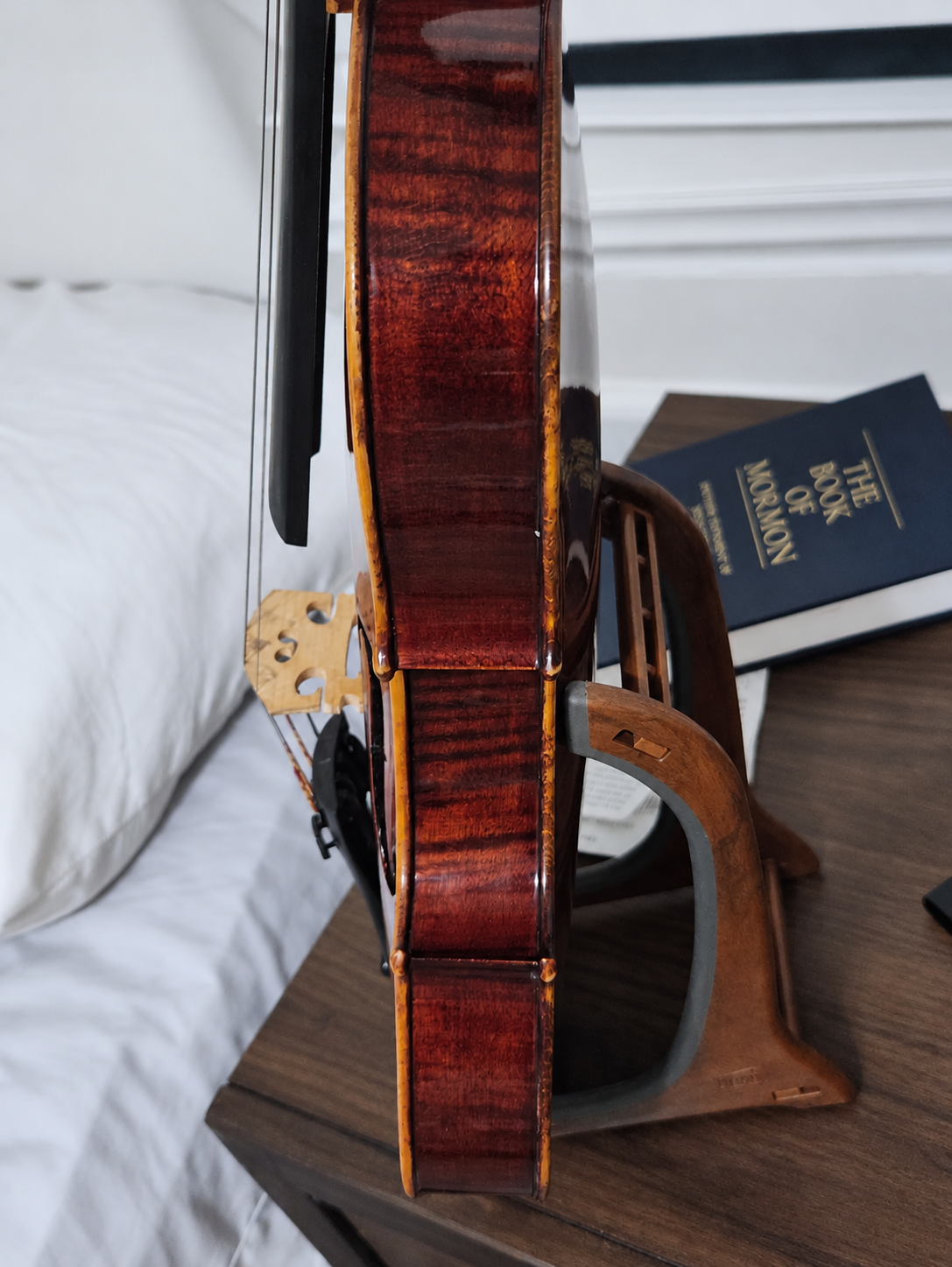
The violin looks thoughtfully made. It has a deeply flamed two-piece maple back, with matching figure in the ribs, neck, and scroll; a fine-grained spruce top; inlaid purfling; shaded antiqued varnish; ebony fittings; and a composite tailpiece with integrated fine tuners. The bridge also appears well fitted. Appearance cannot tell me how it sounds, but this does not look like the cheapest sort of student violin.
From the label, construction, and comparable workshop instruments, my rough estimate is $1,200–$2,500 when new in 2011 and perhaps $700–$1,500 used today. I have not had it professionally appraised, so I would not treat those numbers as more than a working range.
Comparing the two violins§
I made several phone recordings of the red violin and the trainer. They are mono AAC files sampled at 48 kHz. The measurements below describe those recordings; they are not a final score for either instrument.
The companion chapter, DSP Essentials for Violin Noise Comparison, explains the sampling, Fourier analysis, spectrograms, acoustics, and experimental design behind this comparison.
Three measurements were especially useful:
- Harmonic-to-noise ratio (HNR): a rough measure of how cleanly the harmonics stand above noise. Higher numbers generally mean less hiss and scratch between them.
- Spectral centroid: the average “center of gravity” of the sound. A higher value usually indicates a brighter sound.
- Energy in frequency bands: the 1–2 kHz region can contribute a nasal quality, 2–3.5 kHz includes much of the violin's ring and projection, and higher bands can reveal scratch and bow noise.
Explore the recordings
Compare normalized spectra, inspect frequency over time, or listen to the exact analyzed passages.
The same A-major scale material from Record-001, recorded in one session.
Loading the recording…
In the first comparison, the red violin made the stronger showing:
| Mid-register measurement | Red violin | Trainer violin |
|---|---|---|
| HNR | about 14 dB | about 12 dB |
| Spectral centroid | about 1,300 Hz | about 1,800 Hz |
| 1–2 kHz energy | lower | higher |
| 5–8 kHz energy | lower | higher |
The red violin measured cleaner and darker, with less energy in the nasal and scratchy regions. The trainer was brighter and spread more energy across its upper harmonics. In these recordings, that extra brightness did not make it clearer.
The comparison that fooled the analysis§
For the next recording, I played the same A-major scale material on violin A and then violin B. The first analysis leaned toward A: it appeared less nasal, more brilliant, and more dynamically varied. It even suggested that A matched the red violin's earlier harmonic profile.
That identification was wrong. Violin B was the red violin.
Getting it wrong was useful. B still had the cleaner signal—an HNR of about 17.5 dB, compared with about 13 dB for A—but I had given too much weight to tonal balance. Microphone position, the room, and small changes in my playing can move enough energy between frequency bands to disguise the same violin from one session to the next. A spectrum averaged across a whole register is not an instrument's fingerprint.
Across both sessions, however, two patterns held:
| First session | Second session | |
|---|---|---|
| HNR, red vs. trainer | 14 vs. 12 dB | 17.5 vs. 13 dB |
| Centroid, red vs. trainer | 1,300 vs. 1,800 Hz | 1,060 vs. 1,230 Hz |
| Dynamic range, red vs. trainer | 10 vs. 13 dB | 9 vs. 14 dB |
The red violin was cleaner and darker in both sessions. The trainer was brighter, noisier in the upper frequencies, and less even in level. The lower-frequency balance moved around between sessions, so I put less weight on it.
How much of the difference was the bow?§
The red violin came with a bow of its own. I swapped the bows to see how much of the difference belonged to the instrument and how much belonged to the bow.
With the trainer bow, the red violin kept almost the same tonal shape: its frequency bands stayed within about half a decibel. Its HNR fell to about 14.2 dB, however, and the recording gained roughly 5 dB above 8 kHz. It was recognizably the same violin with more bow noise.
The trainer improved with the red bow. Its HNR rose to about 15 dB, although its basic brightness remained. My best reading of the swaps is that the violin contributes most of the tone color, while the bow has a substantial effect on cleanliness and control.
| Combination | Approximate HNR |
|---|---|
| Red violin, red bow | 14.2–17.5 dB |
| Trainer violin, red bow | 15.0 dB |
| Red violin, trainer bow | 14.2 dB |
| Trainer violin, trainer bow | 11.8–13.3 dB |
The red bow added about 2 dB of cleanliness on either instrument. With the bow held constant, the red violin kept an advantage of roughly 1–1.5 dB. Normal variation between takes was around 3 dB, so I consider these suggestive differences rather than laboratory results.
My overall ranking was red violin with red bow, followed by the two mixed pairings, with trainer violin and trainer bow last. The red violin seems better by a moderate margin, and its bow deserves some of the credit for the cleanest results.
A bridge adjustment changed everything§
Later, I corrected the bridge placement and retuned the strings. The next recording was the cleanest one I had made. Mid-register HNR rose to about 19 dB, and the opening scale reached 22.5 dB. Energy in the 2–3.5 kHz “bridge hill” also increased, which is consistent with more ring and projection. The tone became brighter without adding more scratch in the 5–8 kHz range.
The setup mattered more than I had expected. Comparing two violins while one has a misplaced bridge is hardly fair. The high notes still measured less cleanly—about 12 dB from A5 upward—but that may say as much about the beginner holding the bow as it does about the violin holding the strings.
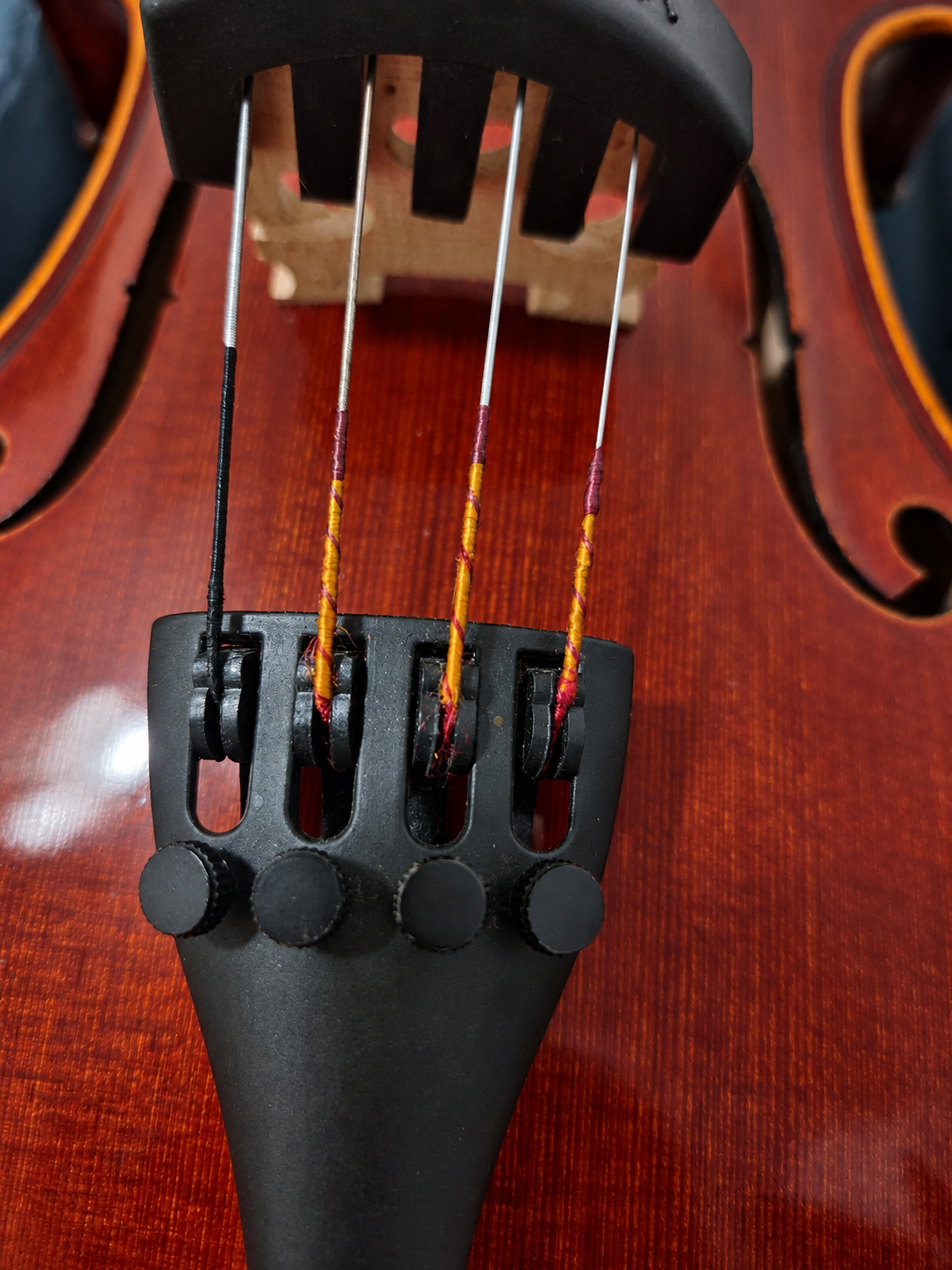
The string silks offered another clue. The E, A, and D have orange silk with red ends and a red spiral, which looks consistent with D'Addario Zyex strings. The G has black silk and is probably a replacement from another set. I still need to check the peg-end colors before calling that identification certain.
One more bow, and an unfinished test§
I also put a brand-new, freshly rosined bow against the other bow and played the same passage back-to-back. The new bow was exceptionally clean in the middle register—23.2 dB against 20.2—but quieter overall and less consistent on the G string and high notes. The other bow was about 3 dB louder, with more body, ring, and dynamic range.
I do not consider that comparison settled. New bow hair often needs more rosin and playing time before it grips dependably. I may also have left the mute on, which would explain why both takes were much darker than the earlier recordings. For a proper rematch I need the mute off, the phone fixed in one place, and several takes after the new bow has been played in.
What I think I bought§
These measurements cannot establish a dollar value, and phone recordings are no substitute for playing the instrument in the room. They did answer my practical question. The red violin repeatedly gave me a cleaner, more focused signal than the trainer, and it improved again after I corrected the bridge. Its bow improved both instruments. The label and construction point to a respectable workshop violin, even though I do not know its exact history or original price.
So the $250 Bookmans violin was not just prettier than the one I already owned. As far as I can tell, it was a real upgrade—and a better find than I understood when I carried it out of the store.